Forum breadcrumbs – You are here:ForumQuản trị doanh nghiệp: Ứng dụngAnaplanAnaplan nằm trong top leader của …
Anaplan nằm trong top leader của giải pháp FP&A

bsdinsight@bsdinsight-com
837 Posts
#1 · 10 December 2023, 17:56
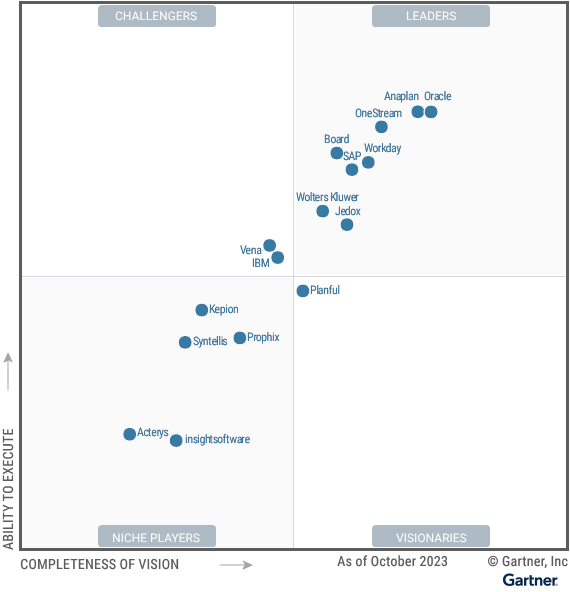
Quote from bsdinsight on 10 December 2023, 17:56Anaplan nằm trong top các giải pháp Finance Planning & Analytics do Gartner đánh giá
Market Definition/Description
Gartner defines financial planning software as the key tool that enables organizations to automate and streamline their enterprisewide financial planning processes. The software supports planning, budgeting and forecasting processes by connecting relevant operational and driver data to profit and loss, balance sheet and cash-flow financial statements. Additionally, the software offers enhanced decision support and analytics that can be customized to unique planning requirements. To provide this support, financial planning software offers data integration, data modeling, reporting and workflow capabilities, which all enhance a user’s ability to effectively manage the planning process and their organization’s financial performance.Organizations use financial planning software to improve their financial planning and decision-making processes. These solutions streamline planning, budgeting and forecasting processes by providing visibility to planning data, consistent application of logic and planning process governance. When implemented in support of sound processes, financial planning software gives organizations reliable outputs to make better informed decisions. This results in improved end-to-end financial planning processes, including aligning strategic priorities with resource allocation to drive improved business outcomes.The common use-case scenarios or business problems addressed by financial planning tools include:
Đánh giá của Gartner đối với Anaplan
Anaplan
Anaplan is a Leader in this Magic Quadrant. Its product, the Anaplan platform, is a cloud-native modeling technology that enables connected planning, budgeting and forecasting with real-time connectivity on a single platform and unified codebase. Anaplan is a private company with customers worldwide and the majority in North America. It serves clients in an array of verticals; its top three include technology; professional services; and banking, finance and insurance. An innovative feature is Hyperblock, a patented engine enabling multidimensional scenario modeling that can recalculate billions of cell values. In 2024, Anaplan expects to enhance its data integration and management capabilities and its AI conversational chat, including NLQ capabilities.Strengths
Cautions
Anaplan nằm trong top các giải pháp Finance Planning & Analytics do Gartner đánh giá
Market Definition/Description
Gartner defines financial planning software as the key tool that enables organizations to automate and streamline their enterprisewide financial planning processes. The software supports planning, budgeting and forecasting processes by connecting relevant operational and driver data to profit and loss, balance sheet and cash-flow financial statements. Additionally, the software offers enhanced decision support and analytics that can be customized to unique planning requirements. To provide this support, financial planning software offers data integration, data modeling, reporting and workflow capabilities, which all enhance a user’s ability to effectively manage the planning process and their organization’s financial performance.
Organizations use financial planning software to improve their financial planning and decision-making processes. These solutions streamline planning, budgeting and forecasting processes by providing visibility to planning data, consistent application of logic and planning process governance. When implemented in support of sound processes, financial planning software gives organizations reliable outputs to make better informed decisions. This results in improved end-to-end financial planning processes, including aligning strategic priorities with resource allocation to drive improved business outcomes.
The common use-case scenarios or business problems addressed by financial planning tools include:
-
Efficiency — This involves automating and streamlining planning processes by eliminating time-consuming and error-prone manual data-gathering processes. It also involves integrating various data sources and enhancing collaboration to minimize the administrative non-value-add burden historically associated with planning processes. Collaboration features allow planners to enter data simultaneously, resulting in greater confidence in the inputs and outputs used to make decisions.
-
Improved Operational Visibility and Management — This applies to providing insights into key financial and operational performance metrics such as revenue, expenses and profitability. By having this information readily available, organizations are better equipped to assess and provide actionable insights based on the entirety of their data assets. Users can identify areas where improvements can be made to increase efficiency and drive value creation for the organization.
-
Complex Business Environment — This encompasses facilitating the integration of financial systems and processes in a complex business environment. It includes providing clear data integration approaches, modeling and analytics capabilities to organizations with high process complexity, a high degree of and varied data granularity, and usually, multiple business lines with various ERP systems, charts of accounts and customer bases across the world.
The must-have capabilities for this market include:
-
End-to-end management of enterprisewide financial planning, budget and forecasting processes — This entails supporting flexible end-user-driven modeling capabilities, customizable planning dimensions and consolidations at the enterprise and business functional level.
-
Administration functionality necessary to support planning activities — This involves the creation and prepopulation of new planning cycles, modification of business rule logic, dimension maintenance and security profile functionality.
The standard capabilities for this market include:
-
Configurable user-friendly reporting and dashboarding — This applies to the ability to generate financial statement reporting (i.e., balance sheet, income statement and cash flow). It also applies to gaining actionable insights into the financial or operational performance of an organization through dashboarding visualizations that allow for a more cross-functional and inclusive approach when explaining trends and results.
-
Built-in audit trails and versioning — This involves the ability to monitor events that occur within the system including data entry, data changes within the planning process and versioning to help users track the evolution of their data and models.
Đánh giá của Gartner đối với Anaplan
Anaplan
Anaplan is a Leader in this Magic Quadrant. Its product, the Anaplan platform, is a cloud-native modeling technology that enables connected planning, budgeting and forecasting with real-time connectivity on a single platform and unified codebase. Anaplan is a private company with customers worldwide and the majority in North America. It serves clients in an array of verticals; its top three include technology; professional services; and banking, finance and insurance. An innovative feature is Hyperblock, a patented engine enabling multidimensional scenario modeling that can recalculate billions of cell values. In 2024, Anaplan expects to enhance its data integration and management capabilities and its AI conversational chat, including NLQ capabilities.
-
Implementation strategy: Anaplan’s global professional services team works alongside its certified partner network to ensure efficient implementation with support based on industry best practices. The company’s agile implementation method emphasizes transparency and flexibility, elevating deployment quality and enhancing customer satisfaction.
-
Integrated planning: Anaplan supports IBP. It connects the planning process and data across finance, supply chain, sales and marketing, and human resources, all within the same vendor solution and on a single platform.
-
Research and development: Anaplan’s market research teams collaborate closely to gather feedback for product development. The teams consist of experts from finance, supply chain, sales and workforce planning who address emerging customer needs via advisory boards. Its recent findings drove the development of a new, comprehensive data management solution that supports the diverse datasets needed for planning.
-
Available license visibility: Anaplan’s product does not natively report visibility into users and available license count in the administration portal, limiting an administrator’s ability to ensure compliance with software licensing agreements. License management reporting, however, is part of its product roadmap.
-
Workflow capabilities: Anaplan’s workflow capability lags other vendors who provide features such as charts, pivot filters and broadcasting capabilities. As it recently released a new visual workflow capability, prospective clients should thoroughly evaluate whether these new additions align with their specific needs and requirements.
-
Pricing: Customers needing extra workspace beyond Anaplan’s current allocation may need to buy additional space. When comparing costs with other vendors, customers should scope and evaluate their current and future workspace and deployment requirements to comprehensively estimate expected costs.
Click for thumbs down.0Click for thumbs up.0